Genomatica和Braskem通过生物学过程一步生产丁二烯

来源于 Chemicals-technology.com

Direct-biological-production-of-butadiene-565px-1

Genomatica和Braskem公司的一组科学家声明他们研发出了一种在实验室通过直接生物反应过程来生产丁二烯的工艺。

自从2015年六月,两家公司就开始在位于San Diego 和 Campinas的Genomatica创新中心进行实验室规模的丁二烯生产。

在2013年, 两家公司就合作开发用可再生原料生产丁二烯的商业应用工艺。

在研究计划执行过程中, 两家公司的研发团队成功在两升发酵器中培育出一种可以消化糖并将其转化为丁二烯的微生物。

Genomatica已经能够在理论上识别出60种用微生物制造丁二烯的生物学方法。

从这60种方法中选取了五种用于实验室验证。

这个研究计划能够进一步提高两家公司的研发技术水平。

Genomatica研发中心高级副总裁Nelson Barton说 “我们的联合团队充分利用Genomatica的整合生物工程平台的计算技术和高容量的克隆和筛选能力迅速完成了一个重要里程碑。”

“只要我们推进这一研究计划,我们合理的菌种设计方法应该能够快速的,可预测的放大和较好的经济性。”

丁二烯用于轮胎,电子设备,鞋业,塑料,沥青,建筑材料和纺织业的橡胶生产,可再生丁二烯有望降低工业生产的碳排放。

七月,Genomatica与美国公司Cargill合作开发可工业应用的可再生化学品。

基于我们的合作关系,两家公司都希望生产出低成本的碳氢化合物原料,同时为化工生产者,分销商和用户提供协同支持服务。


 本人知识有限,如有翻译不当之处,请指正。

Genomatica and Braskem produce single step butadiene through biological process

中文版

From Chemicals-technology.com
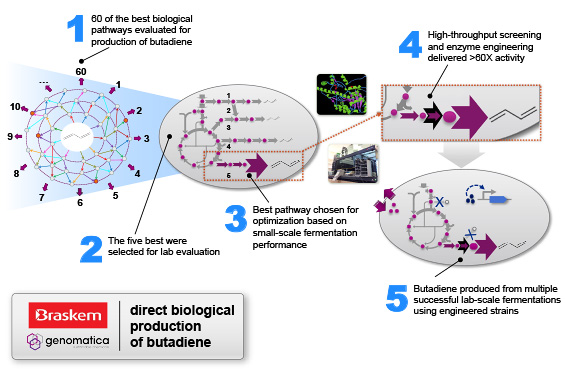
Direct-biological-production-of-butadiene-565px-1

A group of scientists at Genomatica and Braskem have announced that they have produced butadiene through a direct, bio-based process in a lab.

The companies have been producing butadiene in lab scale since June 2015 at Genomatica’s innovation centre in San Diego and Campinas.

In 2013, both Genomatica and Braskem joined to develop a commercial process for on-purpose production of butadiene from renewable feedstocks.

During the course of their programme, the team at Genomatica and Braskem has successfully developed a microorganism that consumes sugar and converts it to butadiene at lab scale, in two-litre fermenters.

Genomatica has been able to recognise 60 possible biological pathways with which a microorganism can make butadiene, theoretically.

Out of those 60 pathways, five were selected for experimental confirmation.

The programme further helps to boost intellectual knowledge of Braskem and Genomatica.

Genomatica R&D senior vice-president Nelson Barton said: “Our joint team has made good use of Genomatica’s integrated bioengineering platform, including its computational techniques and high-throughput cloning and screening, to quickly hit a key milestone.

“Our ‘rational’ approach to strain design should enable faster, more predictable scale-up and better economics as we advance the programme.”

Butadiene is a used in the production of rubber for tires, electrical appliances, footwear, plastics, asphalt, building materials, and latex and a renewable butadiene expects to lower carbon footprint in the industrial output.

In July, Genomatica partnered with American company Cargill to develop renewable chemicals for industrial applications.

With the partnership, both the companies are expected to produce a cost-effective source of carbohydrate feedstocks, as well as co-location support services to chemical producers, distributors and users.


Image: Braskem and Genomatica have successfully achieved direct biological production of butadiene at lab scale. Photo: courtesy of Genomatica, Inc.

Clariant, CB&I win design work for huge Chinese dehydrogenation unit

The world’s largest single-train dehydrogenation unit will process feedstock containing 300,000 tpy of propane and 600,000 tpy of isobutane to jointly produce propylene and isobutylene.

Keywords:

Clariant has been awarded a contract by Hengli Petrochemical (Dalian) Refinery Co. to develop an extensive propane and butane dehydrogenation unit in cooperation with CB&I, the companies announced on Thursday.
The project includes the license and engineering design of the co-processing unit, which is to be built in Dalian, Liaoning Province, China.
The design will be based on CB&I’s Catofin catalytic dehydrogenation technology using Clariant’s tailor-made Catofin catalyst and Heat Generating Material (HGM) to process feedstock containing 300,000 tpy of propane and 600,000 tpy of isobutane for the joint production of propylene and isobutylene.
When completed, it will be the largest single-train co-processing dehydrogenation unit in the world, and will play a key role in Hengli’s expansion plans.
“We are very pleased to be part of this groundbreaking project for Hengli PetrochemicalRefinery,” said Stefan Heuser, senior vice president and general manager for Clariant’s catalysts business. “The contract is further proof that our customers recognize and demand the technological and economical advantages of Catofin and HGM.”
The Catofin process is recognized as a highly reliable and efficient technology for producing propylene from propane, and isobutylene from isobutane. The process operates at optimum reactor pressure and temperature to maximize conversion of propane and isobutene for a high yield of propylene and isobutylene, and correspondingly low investment and operating costs.
Catofin technology provides our customers with proven reliability and the flexibility to co-process multiple feed compositions at world scale capacities,” said Daniel McCarthy, president of CB&I’s technology operating group.
These performance advantages are now further enhanced through the inclusion of HGM in the Catofin process, the companies say.
HGM is an innovative metal-oxide material which is designed to significantly increase selectivity and yield of Catofin units. The material is loaded into the catalyst bed with the catalyst, where it undergoes oxidation and reduction during the operating cycle, producing heat and driving the dehydrogenation reaction.
This not only boosts yields and saves energy, but also reduces emissions. In recognition of its significant step-change contribution to feedstock utilization efficiency, HGM was awarded a special mention by the ICIS Innovation Awards in 2014.
HGM demonstrated excellent performance at the propane dehydrogenation plant of Ningbo Haiyue New Material Co. in Ningbo City, China, according to Clariant officials. Hengli will be the second co-processing plant in China to utilize HGM, following the successful unit designed for Shandong Sincier Petrochemical Co. in Dongying, Shandong Province.


记国家技术发明二等奖项目1-己烯成套工业技术

来源于:中国化工报

近三年的时间里就为国内1-己烯用户节省近4亿元的原料成本,还使国际市场1-己烯产品价格下降了约三成。这就是荣获2015年国家技术发明二等奖的乙烯三聚制1-己烯新型催化体系及成套工艺技术。

用项目完成单位中国石化燕山石化科技部工作人员的话说就是:“燕山石化历时10年的不懈努力,打破了国外厂商对1-己烯的高价垄断,使我国成为全球最早拥有该技术并实现产业化的两个国家之一,同时掌握并拥有了18项具有自主知识产权的核心专利及专有技术,大幅提升了我国聚烯烃产品的市场竞争力。”

共聚单体国外高度垄断

拖了聚乙烯升级后腿

作为生产高附加值聚乙烯的共聚单体,1-己烯在高分子材料、精细化工和制药等领域应用广泛,是一种重要的α-烯烃产品,主要作为生产高附加值聚乙烯的共聚单体。由其生产的聚乙烯具有拉伸强度高、抗冲击、抗撕裂、耐穿刺和高透光等优点,特别适合于生产包装膜、农业用膜以及大口径管材等。随着市场对膜料和管材料需求量的增加,1-己烯的使用量越来越大。然而,直到上个世纪末,国内还没有1-己烯生产技术,产品完全依赖高价进口,而且国外厂商一直对1-己烯实行高价垄断,严重制约了我国聚烯烃行业高附加值产品研发和生产。

1997年中国石化立项开展乙烯选择性三聚制1-己烯工业成套技术的研发工作,由燕山石化承担探索性研究。据燕山石化科研人员介绍,乙烯选择性三聚制1-己烯是上世纪70年代的重大发现,曾吸引了全球十多家跨国公司在该领域进行跟踪研究,均因催化体系对1-己烯的选择性只有60~70%,且伴随较多的聚合物副产物而宣告失败,只有美国一家公司率先取得了重大突破。面对国外严格的专利保护和残酷的竞争压力,燕山石化科研人员在没有技术储备的情况下,从零起步,搜文献、查资料,决定从理论上进行创新实现超越。

科研人员对涉及合成1-己烯有重要影响的催化体系、反应机理、反应器形式等技术因素进行深入研究,对传统聚乙烯催化剂创新性地提出了“三配位”的催化机理,并提出了“占位剂”的概念。通过在催化体系中加入优选的占位剂,使1-己烯反应选择性从70%提高到93%以上,从而在催化剂的选择性上取得了首次重大技术突破。科研人员还发现催化体系组分的进料顺序对反应活性和产品纯度均有重大影响,又从机理入手不断优化,终于开发出了能显著提高催化反应活性的制备工艺。仅用4年多的时间,燕山石化实现了1-己烯制备技术的重大突破,使催化反应的性能有了质的飞越,反应活性和产品纯度均达到了世界一流水平,具备了开展工程放大的技术优势和条件。

技术早一天开发出来

生产企业就少一天困扰

燕山石化科研人员认为:“研发工作不仅是比技术水平,更是比产业化速度。我们的1-己烯技术晚开发出来一天,我国的聚乙烯生产企业就要多承受一天高价进口1-己烯的困扰,聚乙烯产品更新换代的进程就要延迟。”

为了尽快将1-己烯制备技术实现工业化,2003年,“5万吨/年1-己烯的工业开发”科技攻关项目由燕山石化牵头,成立了由基础与应用研究、工程设计、环保研究以及未来装置建设和生产的企业组成的产学研用联合攻关团队。从小试试验的成功,到500吨/年全流程中试放大装置的建成,再到国内首套5万吨/年1-己烯工业装置的顺利建成,一次开车成功,产出合格产品,且投放市场用时不到5年。

项目攻关团队联合对催化剂优化、反应器研制、控制过程优化等十几个课题进行攻坚,先后解决了聚合物堵挂、工艺流程优化、自控方案等多个重大技术难题。特别是通过建立超高雷诺数下的传质、传热模型,设计特定形状和结构的反应器,减少了副产物的生成;通过创建一种构思独特的调控方法,实现了装置的平稳控制与运行;通过开发专有技术,解决了副产聚合物的挂壁和脱除问题等等,最终1-己烯生产工艺技术的工业化应用喜获成功。

经检验,燕山石化1-己烯产品的选择性大于93%,产品纯度大于9.2%。

取得有机原料重大突破

聚乙烯成本三年省四亿

专家评价,燕山石化乙烯三聚制1-己烯新型催化体系及成套工艺技术成果作为国家重点技术创新项目,紧跟国际同行发展进程,打破国外长期高价垄断的局面。其产品主要质量指标和经济技术指标达到和超过国际同类产品和装置的水平,是我国在有机化工原料制备领域的又一重大科技创新成果。

据统计,该项目成果实施后,燕山石化1-己烯装置已累计生产10多万吨产品,被广州、山东、天津等地的多家企业应用,已经占据了国内市场超过90%的份额,迫使进口高价1-己烯产品逐渐退出了我国市场。该项目仅近三年的时间就为国内1-己烯用户节省了近4亿元的原料成本,大大提高了下游生产企业的市场竞争力。同时,作为共聚单体,国产1-己烯已经生产出一系列、不同牌号的高性能聚乙烯产品,为聚乙烯的升级换代作出了贡献。目前燕化1-己烯产品已经出口到韩国、马来西亚、菲律宾等国家,因此国际市场1-己烯产品价格下降了约三成。

有关专家表示,我国1-己烯成套技术的研发成功和5万吨/年装置的投产,填补了国内精细化工产品的又一个空白,有效推动了高性能聚乙烯产品在国内工业、农业和建材领域的应用,具有显著的经济效益和社会效益。此外,该技术的发明,还丰富了催化理论,促进了选择性制备α-烯烃新技术的发展,形成了相关技术研发平台,培养了人才和创新团队。